In researching one side of my family (see my previous post) I came across this story of my great great great great uncle Charles Preston. He was a soldier in the Civil War who died in 1862. I originally assumed based on him being a veteran and the year he died that he died in a battle. I could not be more wrong. The story of the last year of his life seems like something out of a Hollywood mini-series. It is strange, chaotic, and so odd that it seems stranger than fiction (Hollywood hit me up! I’ll even throw in a plot twist).
The first record I found mentioning him was a newspaper clipping from the Eastern Mail in January 1862. He was released in a prisoner exchange with the Confederacy. He had been assumed dead from being hit by a cannonball during the first Battle of Bull Run (which took place in July 1861 – he was a prisoner for six months).
The next record I have for him is him filing a marriage license to marry his stepsister Sarah (Sally) McKenney on February 19, 1862. He would have been back in Maine for less than a month. He was around 21. She was around 15. I like to think that maybe she wrote to him while he was away at the war, and her letters were the ones she liked best. Someone apparently talked him out of this engagement, or he was a bit fickle, because in March 1862 he married Frances Cobb. Frances was the younger sister of Rhoda Cobb, the wife of Charles’ brother William Preston. William had only married Rhoda on February 16, 1862 (Charles’ most have been stricken by the benefits of marriage – and decided to get married to someone/anyone).
Life seems to give Charles’ a quiet few months until October 1862. He takes a trip out on a boat with his wife, her younger brother and sister, her niece, and his younger brother Benjamin (my 3rd great grandfather). Charles’ accidentally crashed the boat, killing himself and all his passengers save for Benjamin. The accident and inquest was featured in all the newspapers in Maine, where Benjamin at 12 years old had to testify what happen.
Charles’ short life was one of many traumatic incidents visited on the Preston family. His brother Alphonso died the following year. One of his other brothers, my ancestor Benjamin, only lived to be 27. Sometimes there is so much trauma visited on a family, it creates a block in family research. It is too painful to talk or write about the family which leads to information and stories not being passed on. Charles’ life, by all account should be memorable. Soldier. Prisoner of War. Twice-engaged in a month. For one year his life was something out a novel, and the only thing remaining is a few documents placed together to show a glimpse of it.
When Chelsea came to me with this project, I agreed readily, and I had a name already ready for it – Maiden Name Unknown. Maiden Name Unknown – is a placeholder genealogists use when a woman’s name can’t be found by them. In genealogy – ancestors and branches of trees can completely disappear because there isn’t a paper trail to support the research. Paper trails can disappear through war, fires, and age. For women, the improvised, former slaves, and other people of color the paper trail was sparse to begin with. Documentation in the United States has favored white men with money – at different times in history only white men were listed on deeds and other real estate transactions, military records, wills, taxes, voting records, and censuses. And of course ancestors who were straight or passed as straight were the only people who had marriage records.
The records slowly diversified where if not all – at least most were given more documentation. But systems of power had already done its damage, and some people will be forever lost. Genealogists in the past tended to favor these systems of power – writing primarily about “success stories” of ancestors who succeeded financially, or socially; and the documentation helped them and backed up their decision to focus on that ancestor. I don’t want to do that – because only certain ancestors throughout history would have been given the accesses needed to succeed; so I can’t ignore my family who didn’t do well.
What this means though – is sometimes it takes a lot more work to write about an ancestor who hasn’t been given an abundance of documentation or been previously written about. Throughout different times in my life, I’ve latched on to ancestor who has had a giant question mark surrounding them, and dug and dug until I filled in as much about them as I can. My current obsession is also my ancestor that is my most recent Maiden Name Unknown – Mrs Preston.
For Mrs Preston I have three pieces of documentation.
The first is a census record from 1850 taken in Bangor, Maine. The 1850 census was the first to list the full white households by name, instead of just head of household and dash marks denoting age and sex of the other residents. In the census she is listed as “Dilaney” what I assume is a phonetic misspelling by the census taker for “Delanie.” It says she was 31 – meaning she was born in 1819 (though typically this could be give or take a year based on what month her birthday was and when the census was taken). It says she was born in Maine. Her husband is Daniel Preston, 10 years older than her. Her children are Alphonso (14), William E (12), Charles H (9), Nancy M (6), and Benjamin F (0 – born in April 1850). The age of her oldest son means she most likely married as a teenager, it could have been a marriage due to pregnancy, and a marriage record would be from 1834-1837. They live next to a man named Ingots Kittredge.
Her youngest son Benjamin Preston is my ancestor. I know one of Benjamin’s daughters has the middle name Delania (a name that pops up a couple times in my family tree) and I suspect she was named after Benjamin’s mother Mrs. Preston.
The second piece of documentation I have is a newspaper clipping from the Bangor Daily News November 6, 7, 8 1850 editions from the local post office in Bangor. The post office listed out people who had letters that needed to be picked up – one of them was Mrs Delano Preston, care of Daniel Preston. I’m working under the assumption that her family may have written to her, meaning that they could have lived outside of Bangor.
(Also – If you are keeping track we now have 4 variations of her first name…but wait there is a more).
My final record for Mrs Preston I found in a property transaction in Bangor in 1853 that involved her husband Daniel. She is listed in one of the paragraphs, giving up her Dower’s Rights (The right she has to a property if her husband dies) as Mary D. Preston. When she signs her name at the bottom of the document it is Mary B. Preston.
(yep 6 choices for a name!!)
I’m currently working on the assumption that her full name is Mary Delania B________ Preston.
3 documents to get this far!
Here are some additional things I know. Daniel Preston remarried to a woman named Winnie Ann Richards in 1858, which means Mary (as I’m currently choosing to call her) died between 1853 and 1858. Daniel Preston does a real estate transaction with his son Alphonso in 1854, where he doesn’t have dower’s rights listed, so Mary may have died as early as 1853/1854.
I followed the property records a little further to find the Prestons lived on the Kittredge Road in Bangor (named after the Kittredge Family that was their neighbor), with enough acreage to mean that at one point part of their property is now where the Wal-Mart I worked at in college is located (the weird connections genealogy brings out).
My leads/My guesses/My dead ends
My dead ends:
Frustratingly one of the places where the mother’s maiden name is listed – marriage certificates for her children – were all issued before that piece of information started being included. Another common lead is death records – I have death records for 3 of her 5 children. 2 died early – Charles and Alphonso, where no parents’ names were asked for. One child – William Preston, frustratingly had his mother’s name left completely blank. Most likely meaning his survivors didn’t know their own ancestor’s name (lost in 2 generations). Benjamin Preston – my direct ancestor – I have yet to find a death record for (outside of a letter from his widow). And finally Nancy Preston, the only daughter, somehow has disappeared from the records. I’m hoping that she got married, and her records can be found someday. Obituaries weren’t fully en vogue yet at that time of the family member’s deaths so nothing has shown up on that end. Daniel is the longest-lived dying in 1906. I also haven’t been able to find a burial or cemetery record for Mary.
My guesses:
Guess #1 – Often neighbors are in-laws or relatives. I’ve started researching some of the neighbors of the Prestons to see if anything manifests.
Guess #2 – Families often marry into other families. Daniel Preston married his second wife who was a widow and had a large brood of children. I’ve looked to see if Mary was a relative of Daniel’s second wife Winnie Ann Richards, or her first husband Almon McKenney.
Another lead on a similar vain Charles and William both married two sisters Frances and Rhoda Cobb. The Cobb sisters lived in Cape Elizabeth, Maine, while the Prestons were located after Mary’s death in Benton, Maine – about 90 miles from each other. I’m wondering if the Cobbs were first or seconds cousins to them and that is how they met (I know – super weird, but that is how the world operated back then).
Guess #3 – The newspaper clipping where her name is listed as Delano, might mean that Delano is a family name. Women often gave their first born child their maiden name as a middle name, and they would go by that as a nickname. If the newspaper clipping is the correct spelling, and everything else is a derivative than Mary’s mother could possibly be a Delano (Side note – I have one ancestor on another side of the family who was named Matthew Coffin Crowley, and went by very creepy name Coffin Crowley).
Guess # 4 – Mary and Delanie/Dilaney both sound Irish in nature. Mary could have been an Irish immigrant. The Irish were pretty heavily persecuted in Maine during the time she would have been alive. She could have lied and said she was born in Maine but was actually an immigrant. My mother and I have some Irish DNA but have yet to find Irish ancestors.
My (hopeful) leads:
I have records of Daniel Preston selling the property he lived on in Bangor, but no records of him or another Preston actually buying it. My hope is that Daniel’s father-in-law was the purchaser of the property, and gave it to his daughter and son-in-law and that if I find who owned the property before Daniel, I can find who Mary’s family is. I’m currently trying to find who the owner in the 1830s sold the property to, before Daniel had it in the 1850s.
Finally asking around for Benjamin’s death certificate. This means calling the town offices where Benjamin lived and asking for a copy.
Someday finding Daniel and Mary’s marriage certificate. Daniel is from New Hampshire – and there are a lot of question marks surrounding him as well. I’ve pursued filling in his information as well, because his life prior to living in Bangor is mostly a mystery. Right now there is a bit of a lack of New Hampshire newspapers that have been digitized – hoping as more come online something will appear.
Figuring out what happened to Nancy Preston, leading to the breakthrough with her mother.
I’ve also been combing the family trees of people who have matched with me and other confirmed Preston descendants on DNA sites, looking for a place Mary might fit in. This is called a triangulation method to find your most common recent ancestor.
I’ve been working on finding more out about Mary and the entire Preston family for about three years. Even when it hasn’t provided conclusive answers it’s lead to finding interesting information about them and their descendants (this is also an explanation on why some of my material on here might seem hyper-focused on one part of my family – it’s the content my research is producing). I sometimes feel like I’m up against the clock when it comes to the research – though more information is coming online, some paper trails are giving away to age. I’m hopeful that I can find Mary’s branch by the end of the year and move on to another family mystery.
I love old cemeteries. The older the better. I’ve been drawn to these sacred locations since I can remember, and I still don’t know what caught my interest in the first place. I like to think that I always knew these cemeteries were filled with lives lived, with history, embodied in headstones both simply and ornate.
My family didn’t raise me to fear death. It was an inevitable outcome, one we’d all face, so why bother to hide from it? It helped, I supposed, that my mom raised me with the belief of reincarnation, the belief that when you die, you’re born again into a new body. I found comfort in this belief, knowing I’d see my mom and grandparents again.
Cemeteries simply stood in memorium of all the people who filled the world. I didn’t want to die, but when I knew what I wanted for my final resting place. To put that in perspective, I didn’t really fantasize about weddings – but I definitely fantasized about my grave.
***
As I grew, I realized quickly cemeteries aren’t filled with live inasmuch as they are quickly filled the forgotten. I often walked through cemeteries, admiring stones, reading inscriptions. Many stones were old and unkempt, ivy or bushes growing up and around them. Others were broken in half, some weakened by nature while others destroyed by vandals. There were some stones with moss so thick the words were no longer legible.
I found it sad, all of these forgotten people. I also learned that not everyone who died did so as an adult. There were so many children and babies spread throughout these cemeteries, it seemed impossible not to consider the pain of a life cut too short.
Sometimes, I cried for the children.
***
I still love cemeteries, and my burial plans have only slightly changed, thanks to one of my favorite YouTube shows, Ask a Mortician. (But more on death and genealogy another time!)
Fast forward over 15 years, and my relationship with genealogy has almost completely changed. I’m just as passionate now as I was then, but I’m no longer naïve about the fact that simply knowing the name of some great-great-great-great grandparent means they are not forgotten. It is not possible to truly know those people – and there are thousands of people that went into making each and every single one of us today – in a way that is truly meaningful.
What we can do is discover more about their lives in the context of their communities and the world they lived in. Through a variety of primary documents, written and oral histories, photographs, and more, we can create a framework and make certain educated guesses about the lives of our ancestors.
***
Why does this matter?
The winners write history. That history often isn’t accurate and leaves out really important things that impact the world – and our personal lives – today. Like our strengths, values, traumas, and cultural memories.
The personal is political; we don’t live in a vacuum. Our family histories, even those not shared with us, contribute –good and bad – to who were today as individuals. We, as individuals, make up the world.
What makes us tick? How do our ancestors impact us today? How do we interact with the stories we learn, or don’t learn, about the people who went into making us? What about our family mythologies, what and how we tell each other? How does the nature of our genetics interplay with the nurturing we experience (or lack of nurturing?)
Names are simply names until we take the opportunity to explore them as complex people who lived and died within a context. They are lingering ghosts impacting us in one way or another, whether directly or indirectly, sometimes in minor and other times in incredibly impactful ways.
***
When I walk through a cemetery, I wonder about the people buried there – the ones with names carved into stones, and the ones buried without a memorial. These places are sacred, and I find more peace in a common cemetery than in any church I’ve visited. Calmness settles, and I am content.
Let’s explore our histories, and the complexities, together.
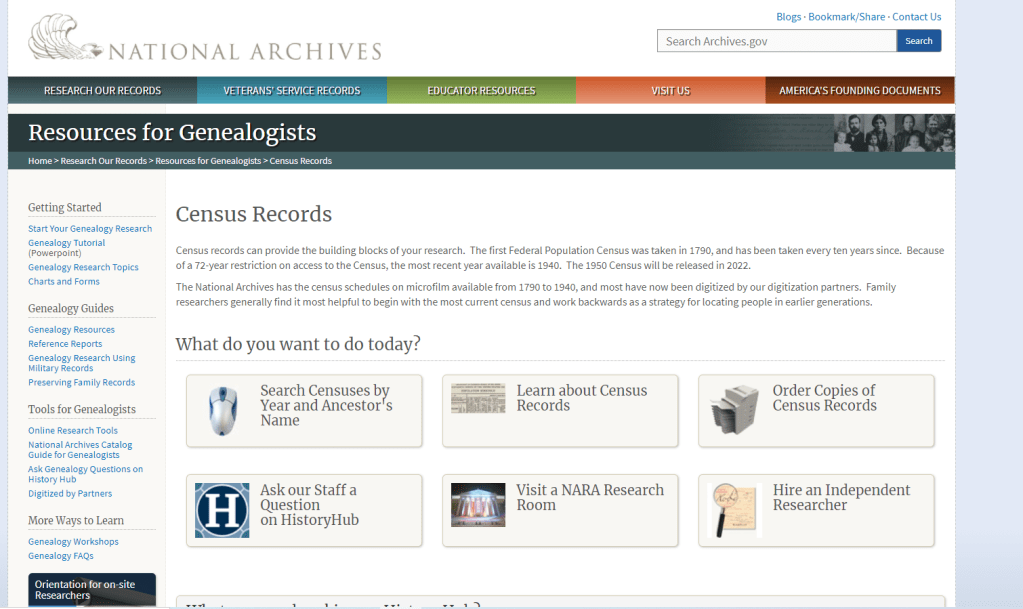
The National Archives is a rich source of information…and not just for finding out how to access information. They have tips and tricks, guides, tutorials, sample charts and forms, resources, and more. It’s one of the resources I keep on hand.
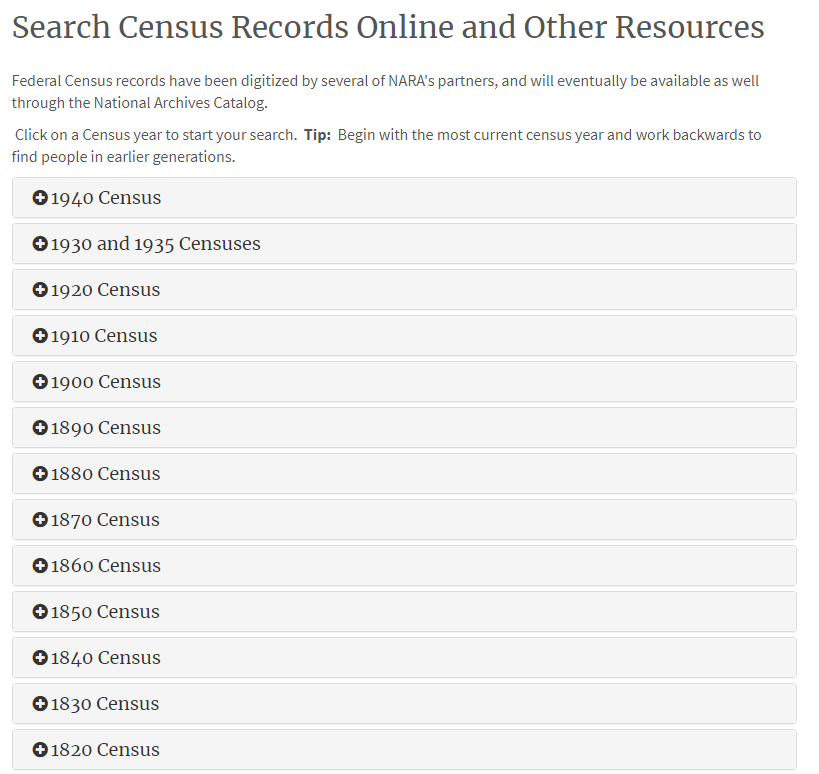
Alas, research is rarely as simply as clicking one page and a year in order to discover all you want to know. Once you click the drop down for census year, several additional options will appear…
Basically, telling you to use a partner site, like Ancestry.com, Fold3.com, or FamilySearch.org. This is where the cost of time and travel intertwine. Ancestry and Fold3 are both paid databases, while FamilySearch is free. If you are at the National Archives (which is a destination on my bucket list of genealogical travels), you can access these websites free.
Odds are, you’re not reading this from Washington D.C. If you are, I’m jealous. If you’re not, many local libraries and/or state archives have subscriptions to these services. So, if you don’t have a library card…get one.
For many reasons, I use Ancestry.com. So, I followed the National Archives directions of moving to a partner database. Once there, I search my great-great grandfather, Hans Bernard Stahl, in the 1930s census records. As a reference to what any of the census forms looked like – because they changed depending on the decade and administration – check out the National Archives Charts and Forms page.
Hans Bernard Stahl (May 8, 1861-October 11, 1931) and Anna Larson Wollen Stahl (April 12, 1872-February 27, 1956) lived in Alpena, Michigan during the 1930 census. As the male, Hans is designated as the “head” of he household. Anna is listed below him and designated as “Wife H”, meaning the head’s (Hans’) wife. Below, two of their grown daughters, Anne M and Florence, as well as granddaughter Gloria, are listed. Moving from left to right, the next group of information indicates that the house they are in is worth $1200, and it is not a farm. Sex and race are followed by age, marital status (married, married, divorced, single, and single), age of marriage, school enrollment, father’s birth place, mother’s birthplace, language spoken, immigration year, naturalization status, if they speak English, occupation, industry, and veteran status.
That is a lot of information that starts to fill in a story, but only as a bare-bones outline. I’m going to use Gloria as an example here.
When I was a kid, Gloria was old. I say that lovingly, because I was raised by the women in my family. I was the youngest, an only child, and spent a lot of time with what I called “my old ladies.” Gloria was a sweet woman, a complete space cadet (aka, very ditzy), loved her fat orange cat, and spent many nights babysitting me. She was often laughing, although she was a worry wart (a trait that runs in my family as well), and loved to tell me I ate like a little bird. She died in 2009.
At the time of the 1930s census, Gloria is 4 ½ years old. The first thing to note is that Gloria is her middle name. Her legal name is “Constance Gloria,” and that is the name that shows up in other documents. Without that knowledge, someone could easily mistake “Constance Stahl” and “Gloria Stahl” as being two different people.
Next, Gloria is listed as Hans’ granddaughter (which she is), but it doesn’t indicate whether Anne or Florence (the two grown daughters) is her mother. There isn’t space for that, since everyone is placed in relationship to the head of the household. We can assume it is Anne, because she is marked as divorced while Florence remains single.
Yet, that still doesn’t catch the complexity. Yes, Anne was married and divorced. But her marriage was short lived, and he wasn’t Gloria’s father. In fact, none of us know who her father was – per my knowledge, Anne never told anyone. But the census records don’t leave room for those complexities, so, without further information, we might make the mistake of assuming Gloria was the product of marriage. In the 1930s, that was an important assumption for people to make. Having a child out of wedlock was scandalous. Anne was a teacher by trade and couldn’t have that reputation, or she’d risk her livelihood and ability to provide for her child.
Just looking at 4 ½ little Gloria alone reveals how important it is to place the census records within a larger story with more research and data. For this example, I easily pointed out what’s missing with just Gloria. I could also explore what’s missing for the others, especially Hans and Anna.
In other instances, I’ve seen name spellings change, dates and ages change, locations of birthplaces changes, and more. Some of it accounts for human error – whether on the part of the individual or the census taker. Language barriers arise, memory fails, literacy isn’t a given, and people lie for many reasons.
And, not everyone is caught in a census. Before slavery, the number of slaves owned in sex and age brackets is listed by number. They are not counted as human. That makes it impossible to track slaves. The 1870 census is the first to track African Americans, although the government began tracking “mortality schedules” for African Americans in the 1850 and 1860 reports. (Read more about African American census and mortality tracking here.)
Native Americans fare just as badly in the census records. They aren’t counted in the census records until 1900, with the exception of a few special cases. New Mexico territory completed a census of Pueblo Indians in 1850, 1860, and 1870. Kansas Territory completed a census of Shawnee Indians in 1857. And a special census was completed in 1880 in Washington Territory, Dakota Territory, and California. (Find out more about American Indians and census records here.)
I’m a sucker for my weekly morning routine. Once I get to work and settle into my desk, I pull up my local NPR station and listen to the news while drinking my coffee and catching up on my email. While listening to the news isn’t everyone’s favorite pastime, I personally find it important … and you never know what you’re going to run across!
Back in March when Tom and I were still in the initial planning stage of Maiden Name Unknown, I was well on my way to catching up with my morning emails when this story came on NPR: “One’s Antifa. One’s In A Militia. How An Ancestry Match Led To An Unlikely Bond.” Researched and written by the talented American journalist Hannah Allam, I was instantly fascinated by the concept.
Ancestry match? That’s genealogy and DNA testing. That’s my jam. I have also reached out to distant relatives for research purposes and even found a third cousin living one city over from me.
Antifa vs. Militia. These two movements are on the complete opposite ends of the political spectrum. And, since you’re reading a blog written from a queer feminist lens, I’m sure you can guess what end we tend to lean toward.
We find ourselves in a time when tensions are high within our politically divided nation. It’s challenging to see across party lines, even within our immediate families. Some people try to do it, while others try to ignore the situation overall, or estrange themselves. There are so many factors that impact the changes in our relationships and the decisions we make regarding them.
During this cultural crisis, an example of genealogy bridging the gap between two strangers holding clashing political beliefs on opposite coasts of nation seems oddly poetic. Of the situation, Allam writes:
Andrew and Cody sit on opposite coasts and opposite sides of the political spectrum, each representing movements accused by the other of fueling domestic terrorism. It’s unlikely they would’ve ever met, much less struck up a dialogue, were it not for their chance connection through a German settler who lived two centuries ago.
In separate interviews with NPR, the cousins said they recognize their bond runs counter to national trends of deep polarization and mistrust. At the same time, they’re careful not to present what Andrew called “a buddy-buddy, antifa-Three Percenter love story.” Their talks are deep and respectful, they said, but the differences are real.
A shared relative, a shared interest, and the willingness to take a chance (Cody on sending Andrew a message, and Andrew by offering a bit of trust) opened a line of communication that is likely to impact both men moving forward.
What I also found fascinating was Cody’s description of loving genealogy and history. He describes visiting obscure cemeteries, searching for old graves, and finding people long forgotten to history. He speaks of not wanting to be forgotten.
That theme is something I recognize. I wrote about it in Contemplating Old Cemeteries a few weeks ago, when I shared a post about my love of cemeteries True death is to be forgotten and, at its root, genealogy is about remembering.
Allam’s article brings to light much of what genealogists often find interesting, while also placing it into the context of the modern era. Whether Andrew and Cody continue their relationship doesn’t matter as much as the moment in time where descendants from two German ancestors were able to build connection two centuries later.
This morning I was reading some of my favorite online clickbait – stories about secrets found out by people about their families from DNA tests. I love the drama of it, the exposing of secrets, the mysteries being solved, or even things completely unknown springing out of nowhere. But reading some of the stories – I start wondering about who has the right to tell the stories when it comes to family secrets? They are exposing it all for the entertainment of the internet. I think about that a bit with genealogy and my own personal history and think maybe some stories aren’t mine to tell, and that is something I have to be okay with.
I admit I probably did go looking for family secrets once upon a time. I purchased 23andme kits for myself, my mom, and my dad – but the results didn’t pack any surprises. I’ve got a few generations traced back via DNA – again the beauty of DNA painting – and there doesn’t seem to be any misattributed parentage (the polite way to say it’s not the right name on the birth certificate, babies switched at birth, or secret adoption). These clickbait stories about DNA does raise the possibility – if the information is out in the open, at least via a website, and there is hard science backing up the information – should things still be treated as secrets? So many people have come to the conclusion the answer is no. Clickbait I have consumed have included stories of closed adoptions suddenly being blown up; DNA revealing to a person they had a White passing parent; or even people being told by a doctor from DNA company they are intersex. In this new age of science and technology we have a wealth of newly available genealogical information, that can change a life within minutes. DNA results have exposed deep secrets that families had intended to take to the grave. I don’t know how society is doing catching up with it all. DNA results have started including a warning on them for a reason, because the infrastructure is not there yet for all people to handle secrets being unlocked.
For society to catch up, I believe reflection needs to be key. Interpreting the data through a lens of humanity is a must. If we stick to just raw facts (which do very much have their place) we will be missing a full and complete picture. But again this has raised the idea, what stories are mine to tell? Genealogists have sometimes chosen to gloss over stories that are too raw; or tried to sanitize them in the retelling. DNA results isn’t allowing that to happen – instead pushing hard truths and dark secrets out into the open. My rules right now are – if there are government documents or newspaper articles, then it isn’t a secret and free to share. If the majority of the people I am writing about are dead, and I’m descended from them it is my story to share. If it is a piece of information that is common knowledge it is mine to share. I want the stories I tell to be ones that are interesting, but not exposés. Of course these are my rules, and I do believe others have the right to do what they need to do with family information.
My hope with this website is to offer nuance, and balance. Part of Maiden Name Unknown is working to tell stories about people who stories might not be told about, to balance out the information that has been gathered by others. The people I’m writing about were real and human. They made mistakes, misjudgments and caused hurt. They also had hopes, dreams, and successes. I want to write about it all, because like it or not, they are who we came from.
On this website, I don’t want the stories I tell to alter someone’s mind completely when it comes to their ancestors. I want to open them to the possibility of seeing people in maybe a new light. A light that is maybe a little harsher at times, maybe a little grittier; or even a little more playful; but at the end of the day a reminder that our ancestors are not some ideal to aspire to; or some monster to runaway from; but people like us.
As I lay in bed the other night, my mind drifted. I love that pre-sleep drift, when you’re so tired your mind begins to shut down, to settle into a shallow consciousness. Your body relaxes into the comfort of your bed to the softening of a stream of consciousness that is outside of your control. For me, this is a rare treat, because it typically takes a lot of work for my brain to settle down and body to process the emotions of the day.
But, sometimes, I’m lucky enough to find a pre-sleep euphoria. This space often becomes a springboard for ideas, some of which I circle back to later in my waking moments. There is no conscious agenda; it almost feels like giving my brain free rein to play.
With the work on genealogy we’ve focused on, even more intensely over the last few months as we planned Maiden Name Unknown, my brain drifted into the following question:
If we were named for the women in our family, instead of the men, what would my name be?
Cultures embrace a variety of naming traditions. I can name my male and female great-grandparents for about the past 150 years. That is rare – hence the name of our blog…Maiden Name Unknown. Since women most often take their husband’s surname through marriage, the children then bear the name of the father. It makes it easier for the unimportant female name to disappear – the women move into a different home and procreate for that particular family lineage. Their brothers marry (or don’t marry…) and then continue the “family” name into the next generation.
Names and heritage are a large part of our identities. I have personally struggled with my last name for decades, because I thought it wasn’t fair that I didn’t have my mom’s last name. After my parents divorce, I primarily lived with my mother, and spent more time with her family than my father or his family. Having a different last name led to this idea that I was an outsider, a message subtly reinforced by extended members as I grew into adulthood. Even as a young child, entering Head Start and beyond, the issue of my name being different from my mother brought many complications and misunderstandings within the school district. And this was the 1990s – it wasn’t as if divorce was all that common.
Chelsea Marie or Chelsea Mariedatter, depending on if my Norwegian ancestors kept or dropped datter.
Let’s explore.
Norwegian families used what is known as a patronymic naming system. This is defined as “a name derived from that of the father or a paternal ancestor usually by the addition of an affix.” In my familial line, this looked like the following… Lars Larsen’s son is John Larsen, and John Larsen’s son is Lars Johnson. To complicate matters, they also tacked on the name of the farm or area they lived in to become even more specific. Skimmili and Vollen are two examples. Using the above-named men, their full names are Lars Lars Skimmili, John Larsen Vollen, and Lars Johnson Vollen.
So, if a father had a boy, -sen or -son was added to the father’s first name. For daughters, -datter or -dotter was often added to the father’s name. When the women married, they retained their birth names but their children will then have the father’s -sen, -son, -dotter, or -datter.
This naming tradition begins to change about the mid-1800s as non-royal families began to adopt one name only. Read more about Norwegian naming traditions here! In 1923, Norway passed the Law on Personal Names, which required surnames to remain fixed. It also required women to take their husband’s surname upon marriage.
There are clearly many layers to dissect, and it’s fascinating to see how culture, laws and power intertwine to create changes in communities. It creates a context for us to understand what is happening during the time our ancestors lived.
To circle back to the question at hand, if Norway had followed a matrilineal naming pattern, what would my name be today?
My great-great grandmother, Anna Larson Wollen, immigrated to Chicago in 1901. Anna immigrated under less than ideal circumstances, so it’s reasonable to hypothesize that she was Anna Larsdatter prior to immigrating. However, when she did make the trip, she switched it to Larson instead. Maybe she did it to integrate more seamlessly into the United States, or maybe she did it to put distance between herself and her biological family. It could have even been a mistake by an immigration official who simply wrote the name down incorrectly. We also see her farm name as Wollen, a common mistake often made when German or Scandinavian languages are translated into English.
In Chicago, Anna marries Hans Stahl and takes on his last name. Moving forward, the family follows the expected patrilineal name pattern we see in the United States.
That information combined, the following matrilineal naming pattern emerges:
Mari (b. 1814)
Marie Maridatter (b 1841)
Anna Mariedatter (b. 1872, immigrated in 1901)
Florence Mariddatter (b. 1908)
Storm Mariedatter (b. 1936)
Pamela Mariedatter (b. 1958)
Chelsea Mariedatter (b. 1988)
This exercise made me giggle. Being raised primarily by the women of my family, this naming system would be far more appropriate. Even so, saying, evening typing, the word “Mariedatter” feels so odd. It isn’t a name you hear; it isn’t familiar like Larsen or Johnson. These are common names, ones that harken back to patronymic naming traditions emphasizing the importance and power of men.
Names are powerful and reflective of societal norms. As you’re exploring your family history, take note of the women who appear in your work, and seek to understand their narratives and essential roles in the lives of their loved ones.
Recently I reached out a woman who had responded to me years ago on a message board. She was descended from the half brother of my great great grandmother, Mabel Preston Lovejoy. She said in her post she had letters written to her ancestor, including letters from Mabel.
I asked – fairly out of the blue – do you still have the letters? Can I have a copy? And to my delight she responded back yes and sent me transcripts.
Seeing the day to day life of some of my ancestors – circa 1950 was enlightening. They discussed money and job woes, their relationships with other members of my family (who they were speaking to who they weren’t), the visits they had, and the emotional struggles they had.
One of my favorite parts though, was some of family talked shit about my great great grandmother Mabel. They mention that she is bad at writing people back – and then Mabel herself writes, scolding herself that she has taken 6 months to respond to a letter and that she should know better, being 78 years old.
I had a moment, where to quote Maya Rudolph as Kamala Harris “that girl was me.” In my professional life, I can shoot out numerous e-mails in the day, and respond to people fairly promptly. When I struggle to respond, typically it is me trying to distance myself often to craft a nicer response, or I don’t want to admit that I don’t know the answer. In my personal life – I’m notoriously bad at responding to e-mails. This year with the pandemic, it has been harder to respond sometimes.
My brain struggles and I often find myself at a loss for words. To know an ancestor had similar struggles more than 70 years ago, made me feel better. I’m not alone.
Mabel’s letters also made me smile, because she sounds so much like the other women in my family. She had a frankness to her – she wrote with very direct statements, in short sentences. She didn’t go in for flourish. She bragged about her roses.
The letters made her feel more like a person, than anything else.
In the following post, I explore intergenerational cycles of abuse.
I’m a survivor of child abuse.
Writing those words feels uncomfortable, because I don’t want anyone to take what I’m about to write about and apply it to other people in my paternal family. I don’t know their experiences, and I have no right to give voice to their experiences. I can only speak to mine with any certainty, and I am going to focus my attention directly on what I lived.
At the same time, I want to make very clear that I am talking about intergenerational trauma experienced through my paternal line. The thought that anyone would think my mom or maternal grandma hurt me in any way is personally devastating. These are the women who gave me strength and taught me to survive. They didn’t know I experienced child abuse, and I learned to disassociate to keep my life with my mother distinctly separate from visits to my dad’s home. Disassociation is a common response to traumatic events.
My mom isn’t perfect – no parent is – but she didn’t abuse or neglect me. In fact, she had the joy of putting up with all of my trauma responses without knowing they were trauma responses and having absolutely zero resources to know or understand what the Hell was happening.
I could write forever about trauma, but that’s not my goal today. If you’re interested in learning more about topics like intergenerational trauma and Adverse Childhood Experiences, I’ll include a few resources at the bottom of this post. I will also share some resources on historic and cultural trauma.
***
You may find yourself wondering … Isn’t this a blog about genealogy? Why is this woman writing about trauma?
Family violence is often swept under the rug, ignored, and victims remain silent. Silence allows violence to continue, and I’ve spent my entire adult life breaking that silence. That silence permeates our family histories, becoming skeletons in our proverbial closets, and it allows these cycles to continue.
Combining oral history and primary documents, I can trace generational trauma in my family back at least 100 years. That is five generations of people: five generations of pain, struggle, and – maybe – resiliency. I’d lay money on it going back even farther, but I don’t have the oral history or records to prove it.
As a child, I didn’t realize I experienced “abuse.” It was simply another way of living, one that I didn’t like.
One exercise I have found to be worthwhile in genealogy research is to track and follow a family through as many census records as you can. Doing this I found I filled in a lot of blanks, gave me some good leads to go on, and highlighted what was missing in my information.
One of the first ancestor and their siblings I did this exercise with was one side of the family that was pretty chaotic. My ancestor Arosine Lodusky Brown was at one point a teenage runaway. Her 2nd husband, Stephen Kimball, was taken to court for their relationship and served 60 days in jail. There is a mythology in my family because of her name that she was Native American. Her parental grandparents are unknown, so right now I’m inclined to believe she was white. Her distinct name also meant that she was hard to follow through records – her name has been listed on various records as Arosine, Arosina, Arzonia, Arizona, Anosine, Loduskie and Lodusky. Arosine’s mother died pretty young so It took a lot of work, and a little bit of money to rediscover part of her family line.
She had 7 children altogether but they are never together in the census, so the tracking helped. The family moved around often bouncing back and forth between different areas of Maine. The family seemed to be in poverty often, which meant sometimes kids were found as servants or in a foster care situation. One daughter disappeared completely (though I recently discovered where she ended up thanks to newspaper clippings).
Below is the notes I made in doing my research. This really helped fill in some blanks because at one point her first child from her first marriage was only listed as adopted. It wasn’t tell he was listed later in life as a sibling in his sister’s household that I knew to dig further.
One of the things with genealogy is sometimes cold facts can bring up some sort of emotion. I felt that seeing the pain my family went through being separated for so long, but also joy the of seeing in their old age my great great grandmother Lydia and her sister Rose each took in one of their brothers.
My mom has talked about her mother and aunt (who married brothers) being the ones who precipitated yearly family gatherings for her father’s family. She said her mother was surprised they didn’t have an interest in seeing each. My mother’s maternal family was big on these gatherings. I think though, it wasn’t some sort of lack of affection that prevented them from having an interest, I think there was some sort of intrinsic knowledge if they needed each other they would be there in the end.
1870 – George Varney – Living in Foster care Stephen Kimball – living with parents Mary Kimball – living with parents Lydia Kimball – living with parents
1880 – George Varney – working in Lowell Maine Stephen Kimball – with Aunt Olive Mary Kimball – Can Not find Lydia Kimball – with foster family Rose Kimball – with family at poor house John Kimball – living with Raynolds family in Ellsworth Fred Kimball – with family at poor house
1890 Fuck 1890*
1900 George Varney – married in Sangerville Stephen Kimball – Living in Lamoine and Trenton Maine Mary Kimball – Can Not Find Lydia Davis – living on Cranberry Island and MDI Rose Kimball – servant in Ellsworth Maine John Kimball – Boarder in Eden Maine Fred Kimball – Boarder in Eden Maine
1910 George Varney – married in Sangerville Stephen Kimball – Living in Massachusetts with wife Agnes and Horace Grindle Mary Kimball – Can Not Find Lydia Walls – Living on MDI Rose Fuller – married with husband, boarders in Portland Maine John Kimball – Dead Fred Kimball – Hired man in Southwest Harbor
1920 George Varney – Can Not Find Stephen Kimball – Living in Lamoine Mary Kimball – Can Not Find Lydia Walls – Living on MDI Rose Fuller – married in Ellsworth Maine Fred – Boarder in Bath, Maine
1930 George Varney – Can Not Find Stephen Kimball – Living in Ellsworth with his wife and Horace Grindle Mary Kimball – Can Not Find Lydia Kimball – Can Not Find Rose Fuller – widowed in Ellsworth Maine Fred Kimball – Boarder in Maine
1940 George Varney – living with Sister Rose in Ellsworth Stephen Kimball- living with Sister Lydia in Ellsworth Mary Kimball – Can Not Find Lydia Walls – living in Ellsworth Rose Fuller – living in Ellsworth Fred Kimball – married in Eden with child
*1890 – a fire in 1921 wiped out most of the 1890 census. It’s devastating to think of how much information was lost.
Addendum – the missing from the census daughter Mary I found thanks to the newspaper archives about a month ago. She married the son of Irish immigrants and was a pretty active Catholic in Ellsworth Maine. Ellsworth was the scene of the fairly gruesome tarring and feathering of a Catholic priest. I’m wondering if she converted for her husband or if part of my family that is hard to trace was Catholic – new clues to a continuing family history!
2nd Addendum – There are also stepchildren of Arosine’s from her husband’s first marriage I need to do this with. I believe they were all girls so a little harder (and they were older – so a lot of the first censuses they wouldn’t be listed in), but definitely worth a shot!



 Maiden Name Unknown