Let’s chat census records. In addition to our little discussion and guidance below, check out this recorded webinar, “Using the U.S. Federal Census 1790-1940: Tricks, Tips, and Hidden Gems,” by the New England Historic Genealogical Society. It’s also important to note that census records are released every 72 years. The next set of census set for release are the 1950s records, which are due to be released in 2022.
The National Archives is a rich source of information…and not just for finding out how to access information. They have tips and tricks, guides, tutorials, sample charts and forms, resources, and more. It’s one of the resources I keep on hand.
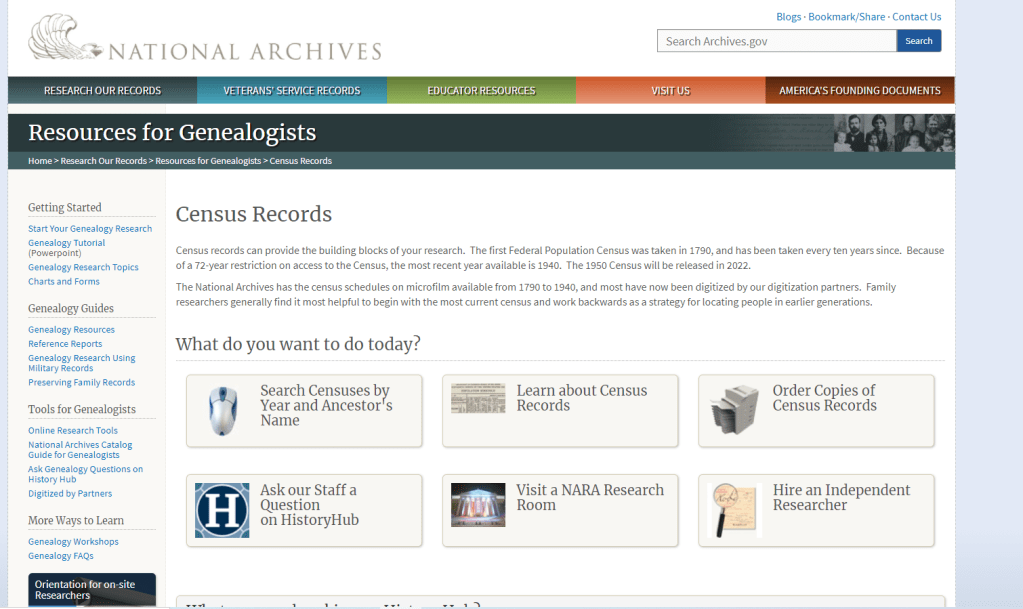
For our purposes, click on the option “Search Censuses by Year and Ancestor’s Name.” Here, a page will appear listing the census years back until 1790.
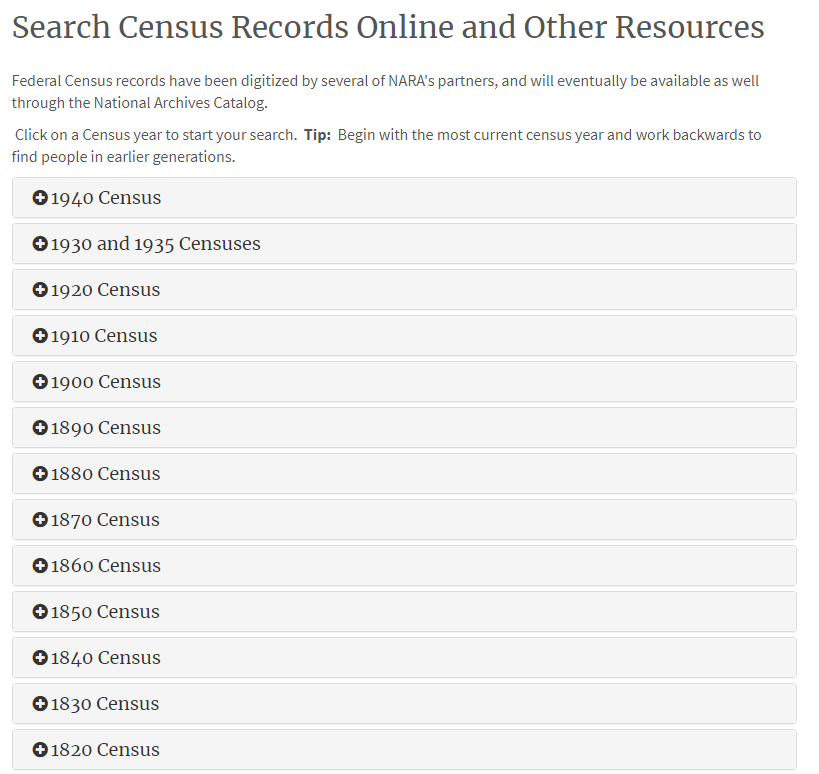
Alas, research is rarely as simply as clicking one page and a year in order to discover all you want to know. Once you click the drop down for census year, several additional options will appear…
Basically, telling you to use a partner site, like Ancestry.com, Fold3.com, or FamilySearch.org. This is where the cost of time and travel intertwine. Ancestry and Fold3 are both paid databases, while FamilySearch is free. If you are at the National Archives (which is a destination on my bucket list of genealogical travels), you can access these websites free.
Odds are, you’re not reading this from Washington D.C. If you are, I’m jealous. If you’re not, many local libraries and/or state archives have subscriptions to these services. So, if you don’t have a library card…get one.
For many reasons, I use Ancestry.com. So, I followed the National Archives directions of moving to a partner database. Once there, I search my great-great grandfather, Hans Bernard Stahl, in the 1930s census records. As a reference to what any of the census forms looked like – because they changed depending on the decade and administration – check out the National Archives Charts and Forms page.
Hans Bernard Stahl (May 8, 1861-October 11, 1931) and Anna Larson Wollen Stahl (April 12, 1872-February 27, 1956) lived in Alpena, Michigan during the 1930 census. As the male, Hans is designated as the “head” of he household. Anna is listed below him and designated as “Wife H”, meaning the head’s (Hans’) wife. Below, two of their grown daughters, Anne M and Florence, as well as granddaughter Gloria, are listed. Moving from left to right, the next group of information indicates that the house they are in is worth $1200, and it is not a farm. Sex and race are followed by age, marital status (married, married, divorced, single, and single), age of marriage, school enrollment, father’s birth place, mother’s birthplace, language spoken, immigration year, naturalization status, if they speak English, occupation, industry, and veteran status.

That is a lot of information that starts to fill in a story, but only as a bare-bones outline. I’m going to use Gloria as an example here.
When I was a kid, Gloria was old. I say that lovingly, because I was raised by the women in my family. I was the youngest, an only child, and spent a lot of time with what I called “my old ladies.” Gloria was a sweet woman, a complete space cadet (aka, very ditzy), loved her fat orange cat, and spent many nights babysitting me. She was often laughing, although she was a worry wart (a trait that runs in my family as well), and loved to tell me I ate like a little bird. She died in 2009.
At the time of the 1930s census, Gloria is 4 ½ years old. The first thing to note is that Gloria is her middle name. Her legal name is “Constance Gloria,” and that is the name that shows up in other documents. Without that knowledge, someone could easily mistake “Constance Stahl” and “Gloria Stahl” as being two different people.
Next, Gloria is listed as Hans’ granddaughter (which she is), but it doesn’t indicate whether Anne or Florence (the two grown daughters) is her mother. There isn’t space for that, since everyone is placed in relationship to the head of the household. We can assume it is Anne, because she is marked as divorced while Florence remains single.
Yet, that still doesn’t catch the complexity. Yes, Anne was married and divorced. But her marriage was short lived, and he wasn’t Gloria’s father. In fact, none of us know who her father was – per my knowledge, Anne never told anyone. But the census records don’t leave room for those complexities, so, without further information, we might make the mistake of assuming Gloria was the product of marriage. In the 1930s, that was an important assumption for people to make. Having a child out of wedlock was scandalous. Anne was a teacher by trade and couldn’t have that reputation, or she’d risk her livelihood and ability to provide for her child.
Just looking at 4 ½ little Gloria alone reveals how important it is to place the census records within a larger story with more research and data. For this example, I easily pointed out what’s missing with just Gloria. I could also explore what’s missing for the others, especially Hans and Anna.
In other instances, I’ve seen name spellings change, dates and ages change, locations of birthplaces changes, and more. Some of it accounts for human error – whether on the part of the individual or the census taker. Language barriers arise, memory fails, literacy isn’t a given, and people lie for many reasons.
And, not everyone is caught in a census. Before slavery, the number of slaves owned in sex and age brackets is listed by number. They are not counted as human. That makes it impossible to track slaves. The 1870 census is the first to track African Americans, although the government began tracking “mortality schedules” for African Americans in the 1850 and 1860 reports. (Read more about African American census and mortality tracking here.)
Native Americans fare just as badly in the census records. They aren’t counted in the census records until 1900, with the exception of a few special cases. New Mexico territory completed a census of Pueblo Indians in 1850, 1860, and 1870. Kansas Territory completed a census of Shawnee Indians in 1857. And a special census was completed in 1880 in Washington Territory, Dakota Territory, and California. (Find out more about American Indians and census records here.)
 Maiden Name Unknown